
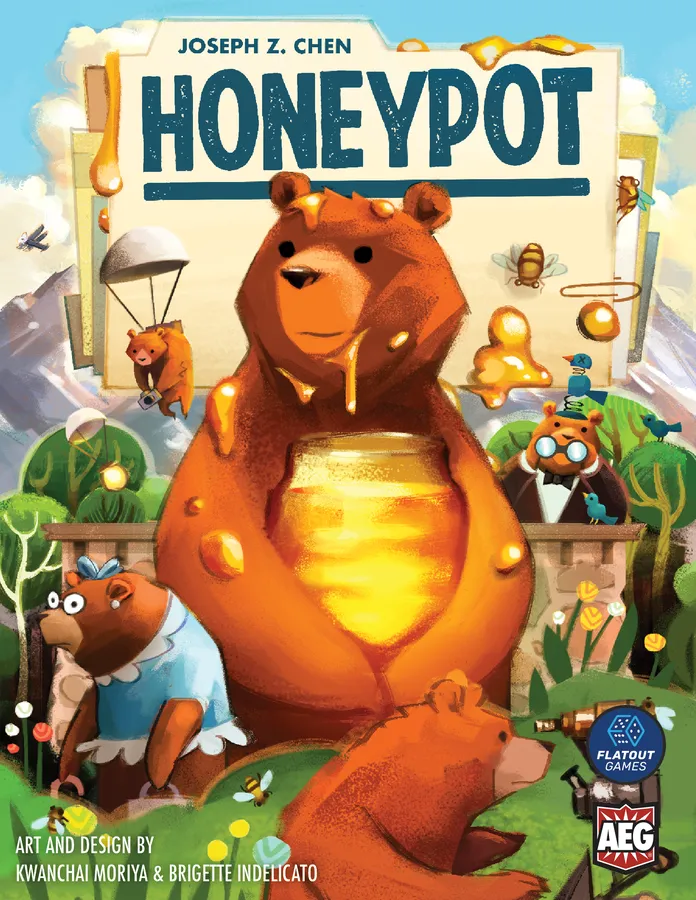
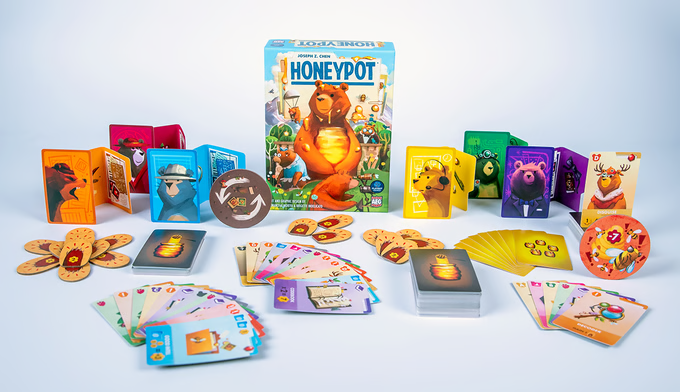
Honeypot – designed by Joseph Z. Chen with art by Kwanchai Moriya and graphic design by Brigette Indelicato – is published by Flatout Games and AEG. Joseph designed one of my favorite games ever, Fantastic Factories (see Colorblind Games Review), so I’ve been eagerly awaiting his next design. It’s also fun to see player counts increasing at Flatout… we’re now playing up to 6!
In Honeypot, players act as secret agent bears, collecting sets of important intel and tools while arranging card groups to trick opponents into choosing point-reducing cards: bad intel, bee swarms, etc. It’s a delightful puzzle that evolves as the game progresses. As each player’s tableau of cards grows, the cards that are “good for me, bad for my opponents” change dynamically.
Honeypot starts with a relatively simple “Sushi Go-style” set collection scoring: the more berries the better, up to 4, but 5 berries is bad; good intel score points, with a bonus for all three types; honeycombs earns 3 points, but also attracts the bee swarm (-7 points).
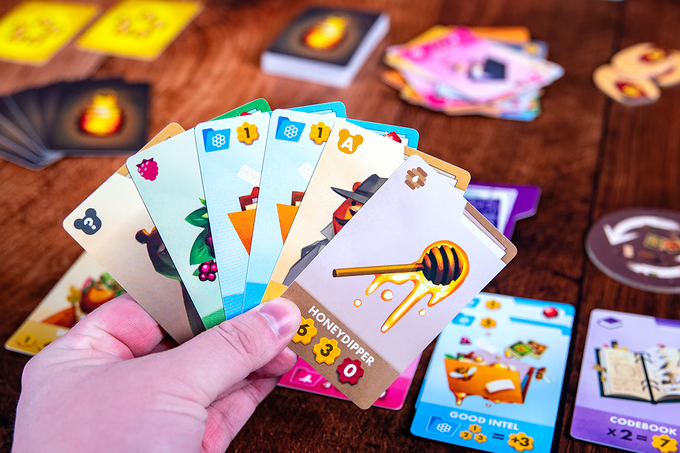
What makes Honeypot special is the gamesmanship of trying to trick other players into taking the worst cards in the secret cache you have arranged. The “I stack, you choose” mechanism leads players to navigate each other more than the game itself. It reminds me of an all-time favorites, Tussie Mussie (see Colorblind Games review). In Honeypot, Joseph and team kept the math simple, focusing on the platform for human creativity and ingenuity.
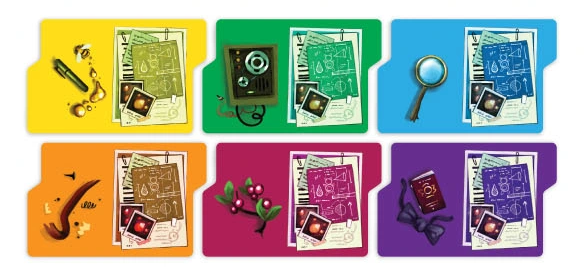
Solo mode
Because Honeypot is strongest with player interaction, it really shines with others around the table. I enjoyed solo as an interesting puzzle, and the designers replicated the “partial information” concept reasonably well, but it feels more like a separate stand-alone game using the same components. The game’s difficulty settings and achievements will make the solo mode replayable, but it lacks the magic of multiplayer.
Visual Accessibility
No notes. Honeypot is fantastic for colorblind and low-vision players. Every card has a unique icon in the top-left corner, large numbers, and clear text. The art is delightful, and it stays out of the way of gameplay-required elements.
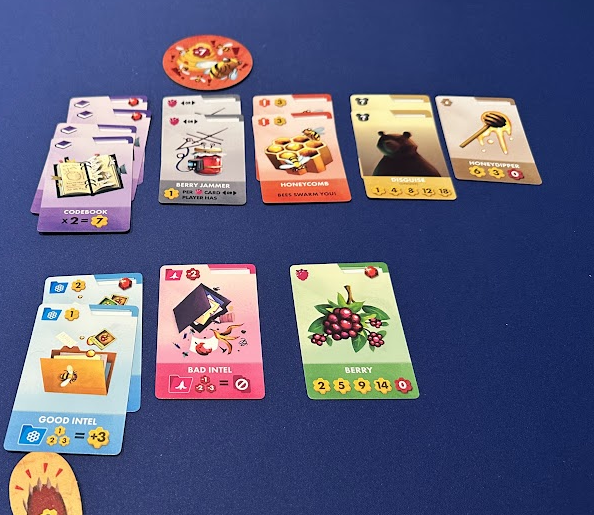
The bee token and swipe tokens are nice and chunky, which can be a production challenge for a small box that’s squeezing in 200+ cards. Incredible work by everyone involved!
Card Backs
Ok, one minor note that’s likely a prototype issue, and not specifically focused on accessibility. In my prototype preview copy, the included mini-expansion adds 32 new cards. The backs of the cards don’t color-match perfectly; the expansion cards are a little lighter than the base game.
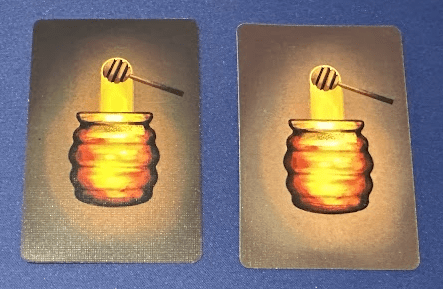
But the joke’s on you, color-vision-normals and eagle-eyes. In this situation, lower visual acuity and color vision deficiency actually help solve the problem. Once I shuffle all the cards together, it’s hard for me to see the difference!
Conclusion
This might be the Flatout Games title with the most direct player interaction. It provides so much fun in a small box, and I can easily recommend it for your game night! Honeypot is available on Kickstarter through mid-March 2026 here: Honeypot Kickstarter
If you’re reading this later, go to Flatout Games to learn more!
- Colorblind Games received a pre-release prototype copy from the publisher for this preview. The published version may include changes to components.
- I have served as a volunteer playtester and rules editor for several Flatout Games and AEG titles (see About Me for details).
- Image Credits: Box art, next image, and bottom image: Flatout Games/AEG. All others: Brian Chandler.

 Colorblind Games