
To wrap up 2024, I’m writing a series of mini-reviews for board games new to me this year. You’ll see a variety of accessibility barriers and some excellent mitigations to help make these games playable for colorblind and low-vision players.
The Isle of Cats Explore & Draw
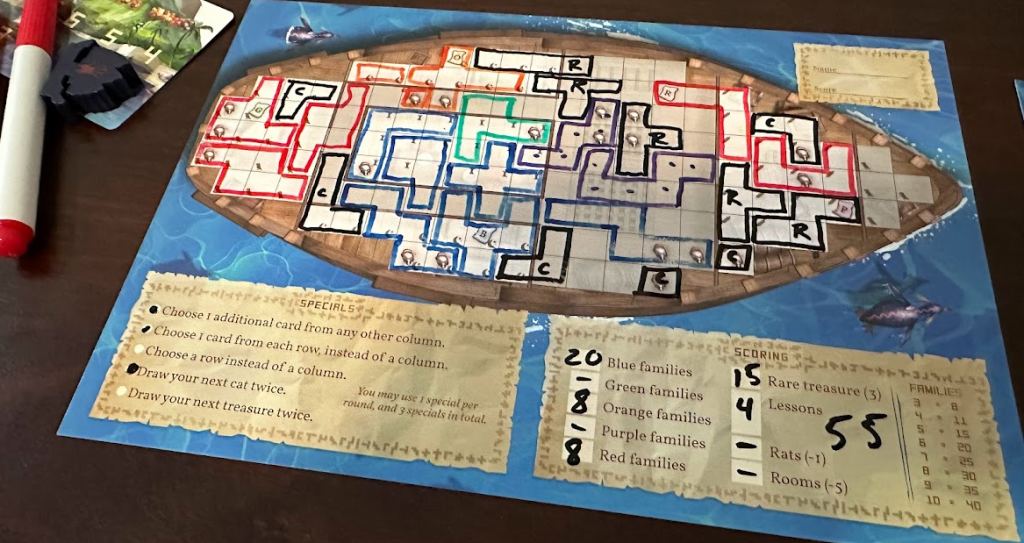
I purchased The Isle of Cats: Explore and Draw after having an amazing experience with color vision accessibility in the original The Isle of Cats (Colorblind Games review). Polyominoes are one of my favorite mechanisms, and this game evokes the original tile-layer effectively.
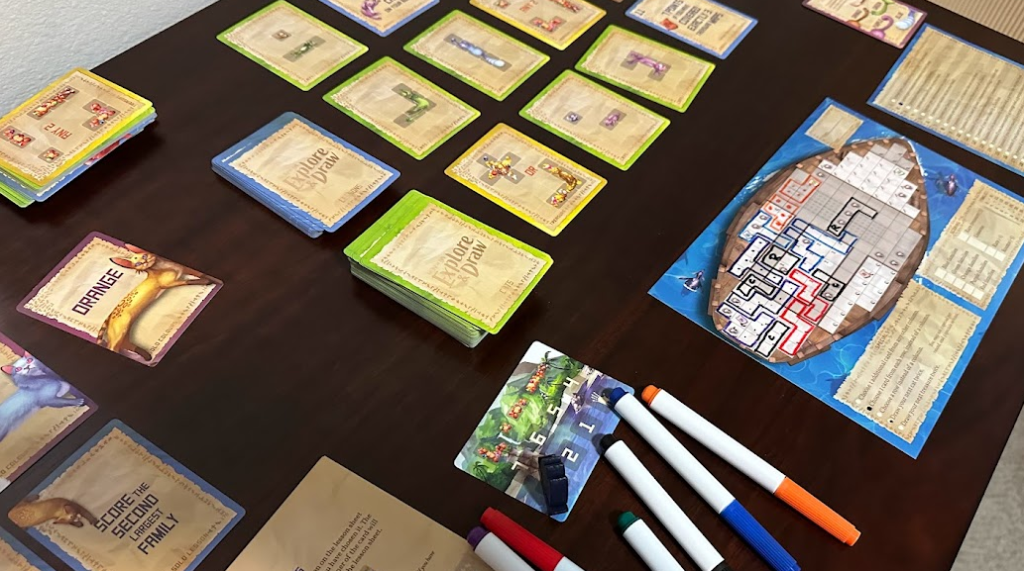
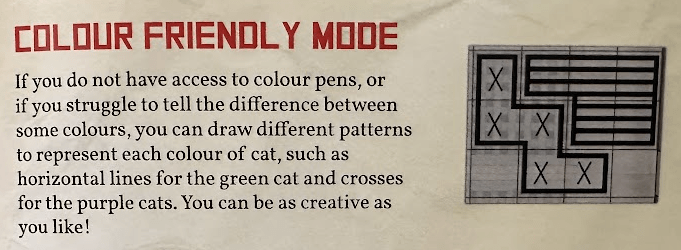
Unfortunately, color vision took a step back in Isle of Cats: Explore & Draw. By trading out the double-coded cat tiles and meeples of the original game with colored markers, I found it more difficult to play. The publisher recognized this, offering a recommended mitigation in the rulebook.
Bargain Basement Bathysphere
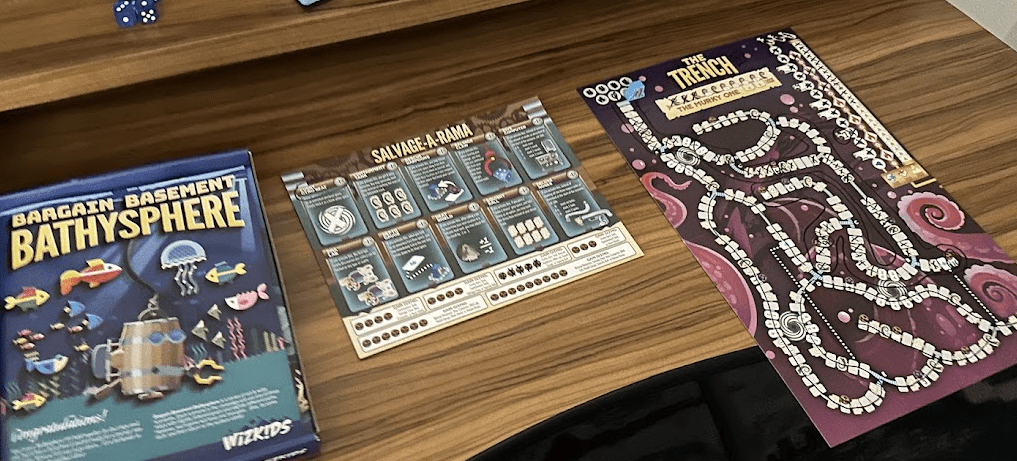
I enjoyed the whimsy and unique theme of Bargain Basement Bathysphere from Scott Slomiany and WizKids. Players are owners of “the leakiest bathysphere this side of Beachside Bay,” exploring the ocean’s depths on increasingly challenging missions.
Bargain Basement Bathysphere started as a print-and-play game, which is often a great sign for color vision accessibility. I did not experience any accessibility barriers while playing, and I’m excited to get this one back to the table in 2025!
Flamecraft
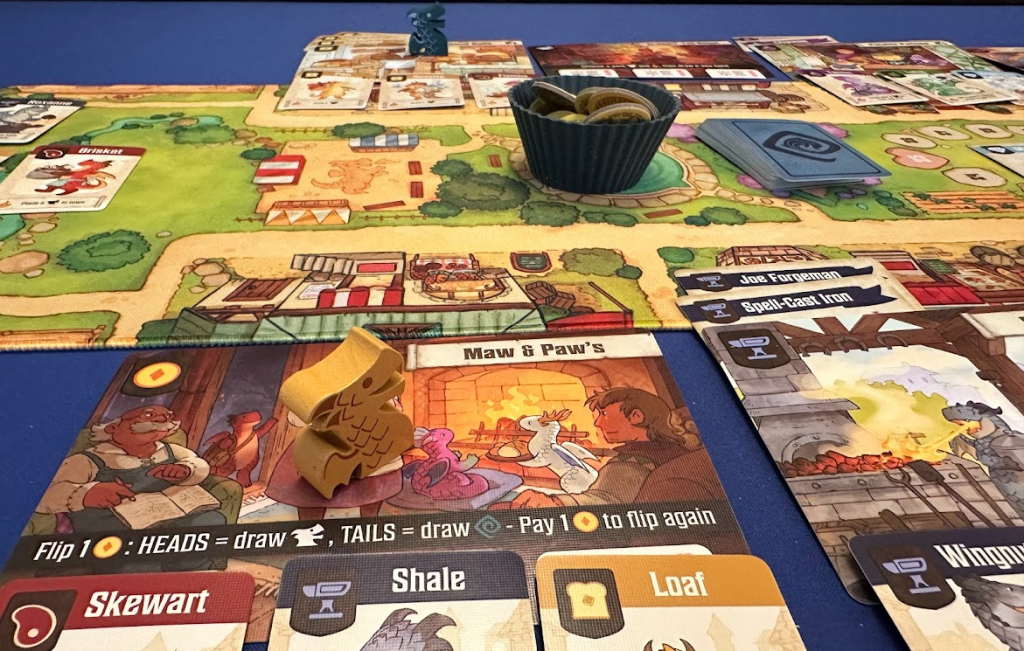
Designed by Manny Vega, Flamecraft has players gather items and work with specialized dragons to earn reputation and favors from the dragons within each shop. I found Flamecraft an ordinary recipe fulfillment game that was bolstered with extraordinary art and theme.
Graphic design and double-coding are solid, so I did not encounter accessibility issues during 2-player games. At higher player counts, some might experience issues discerning between some of the six player colors. The palette is pretty good for my specific color vision deficiency, but the green/red combo could be challenging for some.
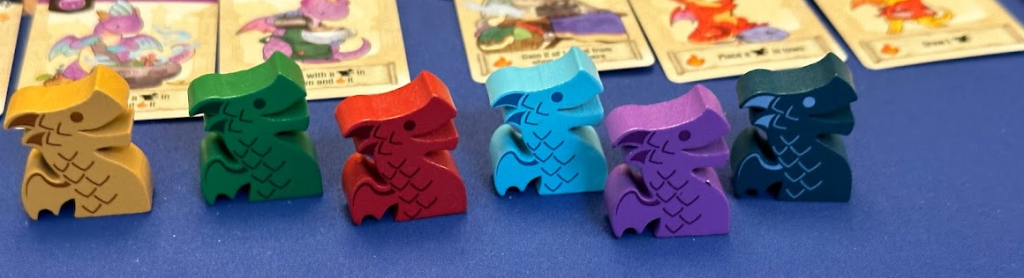
Making the blue/purple dragons three different shades (light, medium, dark) helps, and the light-colored screen printed art on the darkest piece adds another clue. Light-colored printing on the green dragon would help, too.
Star Wars Unlimited
In the recent flurry of new trading card games this past year or so (see the Colorblind Games review of Lorcana), Star Wars Unlimited from Fantasy Flight Games immerses players in strategic 2-player battles between the Galactic Empire and Rebel Alliance. The core gameplay revolves around deploying units, using leader abilities, and executing strategies across two distinct areas: ground and space.
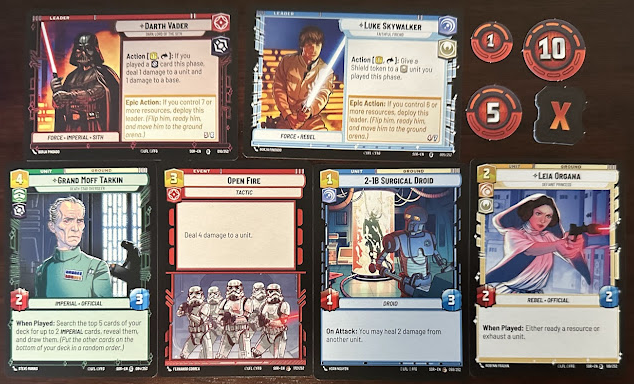
The accessibility of Star Wars Unlimited is quite good, with double-coding for all color-based iconography. Tokens in 1, 5, and 10 denominations are clearly identified and different sizes.
Arkham Horror: The Card Game
While not the new hotness, Arkham Horror: The Card Game (designed by Nate French and MJ Newman) is a perennial Board Game Geek Top 100 game. In it, a team of 2-4 investigators use their customized decks of cards to unravel mysteries in the haunted New England town. Each investigator must keep an eye on both health and sanity during individual adventures. Additionally, choices and actions will have consequences through a multi-game campaign.
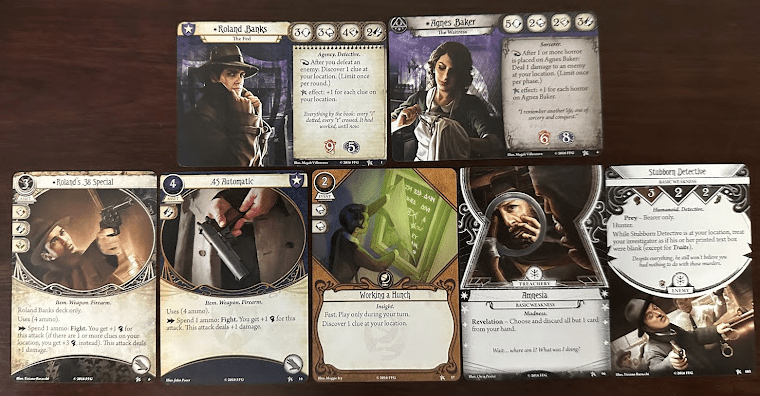
Arkham Horror: The Card Game handled colorblind accessibility well. Cards include abundant text, identifiers, and symbols that complement a “good enough” color palette. All tokens have distinct double-coding beyond color, too.
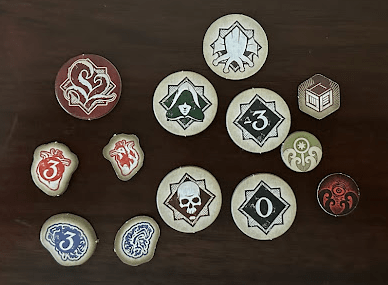
Low-vision players will have trouble, especially during deck construction and scenario building, since small symbols and numbers must be used to sort and select cards. Adding to the challenge, some of the symbols are similar to each other.
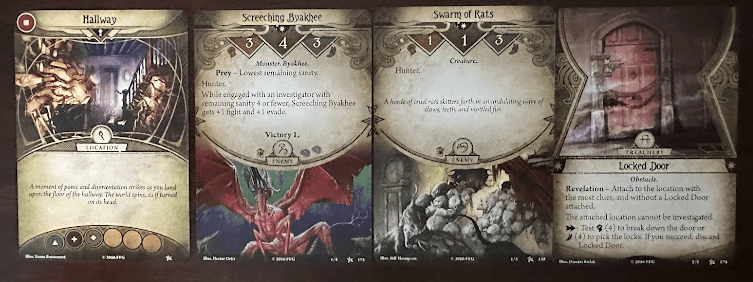
I made regular use of the magnifier feature of my phone to build each scenario, but then I played solo games without assistance devices, especially after I learned the cards.
Star Wars: The Deck Building Game: Clone Wars Edition
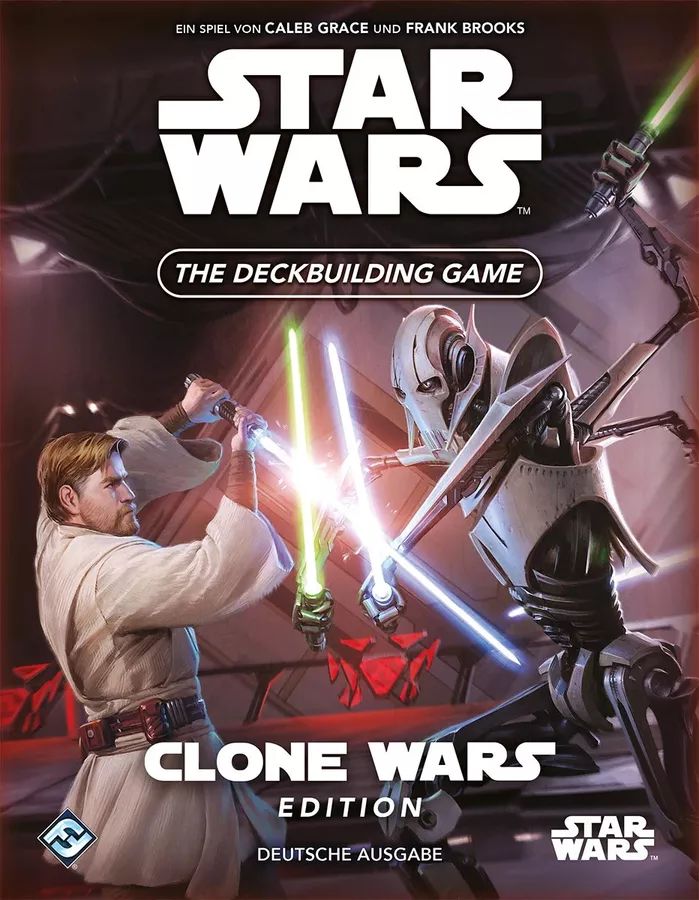
I included Star Wars: The Deck Building Game in My Favorite Things: 2023 last December. The love affair continues, as I’ve now played well over 100 games of the original, this Clone Wars standalone expansion, and mix-and-match games that combine elements of each.
The original had excellent colorblind and low vision accessibility features, including double-coding and a good color palette. The expansion comes close to matching the original for accessibility, with one notable exception. The faction colors and icons are closer to one another in Clone Wars Edition than in the original game (Red Rebels vs. Blue Empire). While the colors are distinguishable by iconography, it takes me another second or two each time to determine whether a card is a Separatist or Republic.
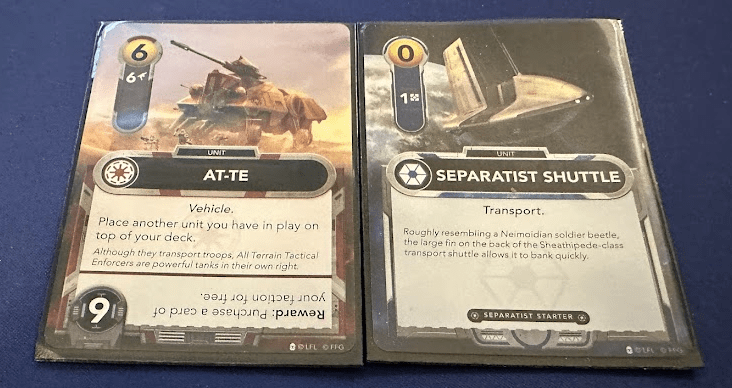
I realize this is a difficult problem to solve, given the established icons and color schemes of the Star Wars universe, and it’s not been enough to require a modification, but it was a small “feel bad” after the base game was so easy to play.
The Lord of The Rings: Duel for Middle-earth
Lord of the Rings: Duel for Middle-earth is a two-player strategic board game that brings the epic conflict between good and evil from J.R.R. Tolkien’s legendary world to life. Players choose to represent The Free People or Sauron. A reimplementation of 7 Wonders Duel, mechanisms include card play, area control, and resource management. Each player has the same three win conditions, any one of which ends the game immediately:
- Ally with 6 factions of Middle-earth
- The Ring: destroy at Mount Doom (Fellowship) or capture Frodo (Sauron)
- Military presence in all 7 locations of Middle-earth
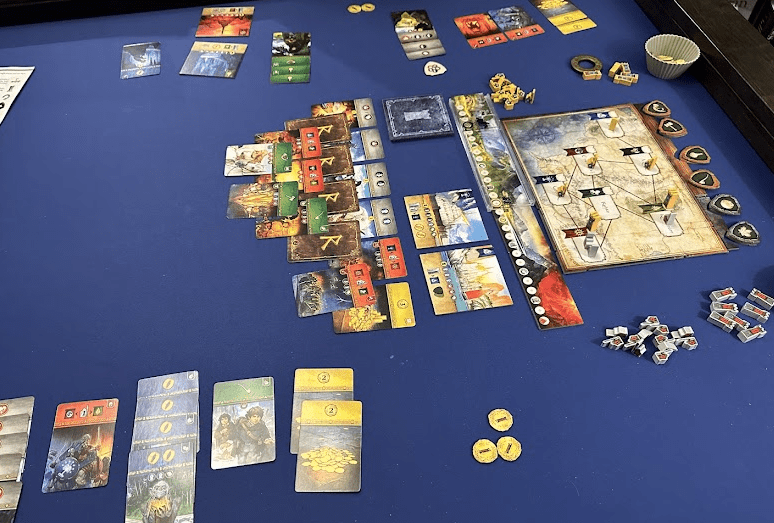
Visual accessibility is excellent, and I could play the game without support. The five card colors are in a decent palette, and each is distinguished by its topic and related symbols (e.g., all ring-related cards are blue). The two player colors are yellow and grey, which I found easy to see.
In Summary
2024 was a great year in board games, and I am encouraged that visual accessibility continues to improve. However, we still have a long way to go. I look forward to the day when unintentional accessibility barriers disappear…maybe 2025?


 Colorblind Games