

Great Western Trail: Second Edition is designed by Alexander Pfister, with art by Chris Quilliams and published by eggertspiele, among others. Players take on the role of ranchers herding cattle from Texas to Kansas City, then sending them off by train to earn money and victory points. Buildings, cowboys, builders, and engineers provide support along the way. For a full game review, see Brian Ellis’ article at Above Board.
The Good, the Bad, and the Ugly
There is a lot happening in Great Western Trail, and the game provides mostly accessible components for colorblind and low-vision players, with some exceptions.
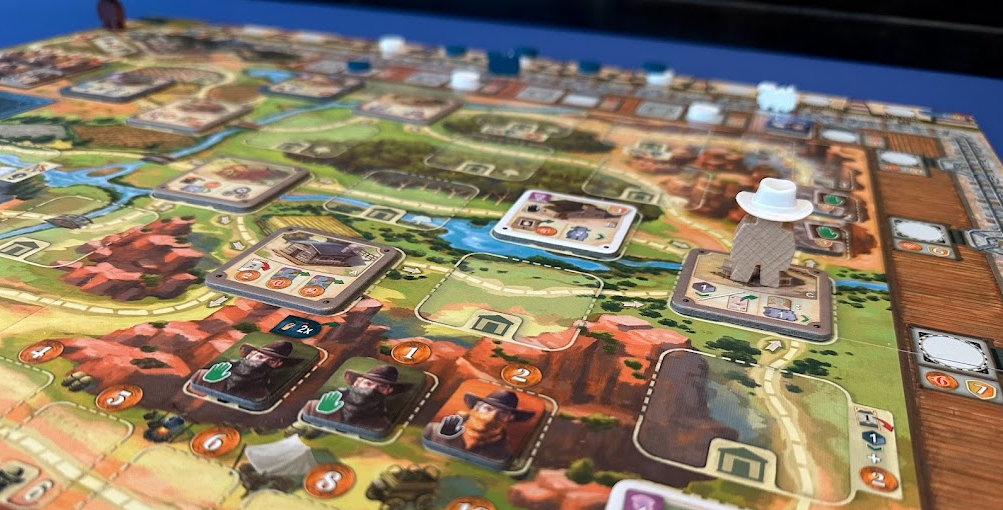
THE GOOD: Color Palette, “The Hands.” Player colors of white, yellow, red, and blue will be easy for most players to discern from one another, even those with some color vision deficiency. In particular, I appreciate a game that includes white or black as a player color. Similarly, the black and green “hands” used on the two types of outlaws are easy to distinguish from one another.
THE BAD: Icons for Workers and Outlaws. Great Western Trail provides three types of workers: cowboys, builders, and engineers. Each has a distinctive silhouette based on their hat, and each also has a background color. But at on-the-table size, these can be confusing.
Similarly, the orange and green outlaw icons (e.g., on the building cards shown below) were sometimes difficult for me to distinguish during play.

THE UGLY: Icons Referring to Cattle Cards. Unfortunately, the iconography on some other game components created an unintentional barrier. For example, cattle cards are sometimes identified by color and cost, but not by name. Here’s an example from the Engineer worker row, which refers to the cattle only by color and cost. On this and some building tiles, the numbers and colors were not enough information for me to easily distinguish among cattle cards.
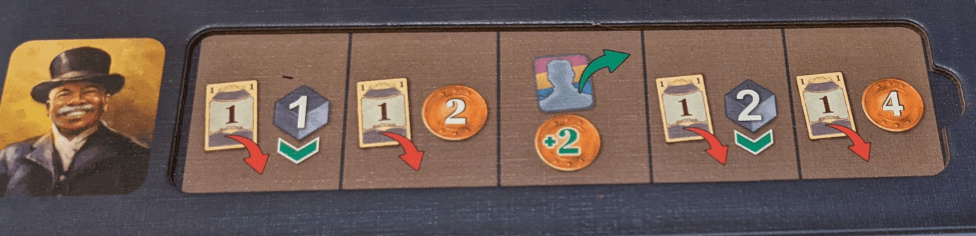
Playing solo, I made a reasonable guess at the card in question by combining the cost with a “close-enough” color, but it was sometimes frustrating.
The Dust Settles
Great Western Trail: Second Edition is an excellent game with less-than-perfect but manageable color vision and low-vision accessibility accommodations. Don’t shy away from it if you are colorblind or low-vision, but give yourself some extra time or seek support along the way.
Image Credits: Cover art by eggerspeile. All others by Brian Chandler.

 Colorblind Games